Google vs Bing
Google vs Bing Easter Eggs: The Complete 2026 Comparison
Google wins decisively on Easter egg depth and variety — with 17+ confirmed hidden tricks, games, and visual effects. Bing has a smaller, less consistent Easter egg tradition but does offer a playable Snake Game, a built-in Calculator and Unit Converter, a Solitaire game, and has historically had a few fun tricks. What Bing is most famous for in internet history has nothing to do with Easter eggs, and everything to do with a plagiarism scandal involving a fake search query. That story, and the honest rundown of what Bing actually offers, is what this article is about.
When someone asks “does Bing have Easter eggs like Google?” they are usually asking two different questions at once. The first is a simple product comparison: which search engine has more playful surprises built in? The second is a memory of something they heard about Bing doing something unusual or embarrassing — something about copying, or a weird search result, or Microsoft doing something that made it briefly viral on the internet.
Both questions deserve real answers. This guide gives them.
The Benchmark
Google Easter Eggs: The Benchmark
To compare fairly, it helps to establish what Google actually has. Google has spent over two decades hiding interactive tricks, games, and visual effects inside its search results. These are not accidents or bugs — they are deliberate engineering decisions, usually tied to a cultural reference, an anniversary, or an internal engineering joke that someone had enough credibility to ship.
- 🌀 Do a Barrel Roll — Search do a barrel roll — the entire results page rotates 360°. From Star Fox 64 (1997).
- 👾 Google Pac-Man — Search pac-man — a fully playable Pac-Man game with original sounds. All 255 levels.
- 🦕 Google Dinosaur Game — Search dinosaur game — the iconic Chrome offline T-Rex runner, now always available.
- 🐍 Google Snake Game — Search snake game — multi-theme Snake with difficulty levels and themed maps.
- 💎 Google Solitaire — Search solitaire — Klondike Solitaire in easy or hard mode.
- 💣 Google Minesweeper — Search minesweeper — three difficulty levels with the classic grid.
- 🌪️ Askew / Tilt — Search askew or tilt — results page tilts at a slight angle.
- 💥 Zerg Rush — Search zerg rush — Google O’s attack and consume the search results. StarCraft reference.
- 🟣 Google Gravity — Search google gravity in I’m Feeling Lucky — page elements fall to the bottom of the browser.
- 🌈 Google in 1998 — Search google in 1998 — results page reskins as the original 1998 Google interface.
- ✨ Blink HTML — Search blink html — the words “blink” and “HTML” in all results flash on and off.
- 🌬️ Wizard of Oz — Search wizard of oz — 80th anniversary restoration showing ruby slippers, tornado, and poppy field animations. (Note: May be retired — verify in search.)
- 🪄 Thanos Snap — Search thanos — the Infinity Gauntlet glove erases half your results. (Currently retired.)
- 🎬 Google Atari Breakout — Previously triggered on Google Images search for “Atari Breakout.” Retired May 2020.
- 🎰 Flip a Coin / Roll a Die — Search flip a coin or roll a die — animated randomizers. Practical as well as fun.
- 42 The Answer to Life (42) — Search the answer to life the universe and everything — calculator shows 42. Hitchhiker’s Guide reference.
- 🔢 Conway’s Game of Life — Search conway’s game of life — animated cellular automaton plays in the knowledge panel.
That is 17 confirmed Easter eggs, with several more seasonal or regional ones that have appeared over the years. It is not a coincidence that Google’s engineering culture, which prizes 20% projects and internal experimentation, produced this catalog. Easter eggs are a byproduct of a company that gives engineers creative latitude.
The Challenger
Bing Easter Eggs: What Actually Exists
Bing’s Easter egg history is shorter, less consistent, and more difficult to verify independently. Part of this is structural: Bing’s search results interface has changed significantly more than Google’s over the years, meaning features that existed in one version may not survive to the next. Part of it is cultural: Microsoft’s engineering culture, while creative in other areas, has not historically produced the same volume of search-integrated Easter eggs.
Here is what we can verify with confidence:
Bing Snake Game
Bing does have a playable Snake game. Searching “snake game” on Bing triggers a Snake game within the search result — smaller and less feature-rich than Google’s multi-theme version, but genuinely playable. This has been consistently reported by users and documented by Search Engine Land and Ubergizmo. It is arguably Bing’s most direct parallel to a Google Easter egg.&lp>

Bing Calculator and Unit Converter
Bing’s built-in calculator is more fully featured than Google’s for some mathematical expressions. Unit conversion, currency conversion, and certain mathematical queries produce rich interactive results. These are not Easter eggs in the traditional sense — they are intended, visible utility features — but they are worth noting in a comparison of what each search engine offers beyond the standard blue links.
Bing Solitaire
Bing has offered Solitaire through its search results. As with the Snake game, this is a smaller, simpler implementation than Google’s version. Its availability has varied across Bing interface updates.
Bing Homepage Spotlight and Daily Images
Bing’s homepage is famous for its daily full-screen background photograph with a hidden “hotspot” — a clickable area that reveals trivia or a short article about the featured image. This is not a search Easter egg, but it is a deliberate piece of designed delight that Bing has committed to far more consistently than Google ever did with its homepage. Some users find this more genuinely interesting than Google’s hidden tricks.

A note on claimed Bing Easter eggs: Several sources — including older articles and forum posts — claim Bing has an “Atari Breakout” Easter egg similar to Google’s, triggered by searching “Atari Breakout” on Bing Images. This claim appears to conflate Bing with Google’s now-retired Atari Breakout Easter egg and cannot be independently verified as an active Bing feature. We are not including it as confirmed. If you have tested this recently, search results may vary by region and date.
Bing “More Evil Than Satan” (Voice Search History)
At various points in Bing’s history, voice search queries that were misheard produced unintended humorous results. The phrase “Bing is more evil than Satan himself” — a variation of an autocomplete or misrecognized voice query — circulated as a screenshot across tech communities around 2013–2015. This was not an intentional Easter egg but became a minor internet moment. Bing representatives confirmed it was a voice recognition artifact, not an engineered surprise.
The Rivalry
The Biggest “Bing Easter Egg” Story: Copygate
No article comparing Google and Bing can responsibly skip this. In February 2011, Google engineer Amit Singhal and Matt Cutts publicly accused Bing of copying Google’s search results. The story made front pages across the technology press and became one of the most discussed incidents in search engine history.
What Happened: The “Hiybbprqag” Experiment
Google engineers noticed that some of their own search results — including results for highly unusual, nonsensical queries — were appearing in Bing’s results shortly after. To test the theory, Google created a “honeypot”: they planted fake search results for nonsense terms like hiybbprqag and mbzrxpgjys — strings of random letters that returned no real results and could not logically be indexed from any real web content.
Within weeks, the same fake results appeared in Bing’s index. Because the query was nonsensical and the results were manufactured specifically for the test, there was no way Bing could have arrived at those results independently. Google’s conclusion: Bing was using Internet Explorer’s Suggested Sites feature and the Bing toolbar (both installed on many Windows machines) to observe what Google users searched for and what results they clicked — then incorporating those signals into Bing’s ranking.
Microsoft did not deny using clickstream data as a ranking signal. Bing VP Stefan Weitz said Bing used “multiple signals” including user behavior data, and that “none of those signals” constituted copying. The tech community largely disagreed. The incident was dubbed “Copygate” by bloggers and press.
Why bring this up in an Easter eggs comparison article? Because “Copygate” is the single most famous story in the Google-Bing rivalry, and it directly involves what one search engine does versus the other. Readers who look up “google vs bing” or “bing copies google” are looking for context on this event. Omitting it would be a disservice.
It also illuminates a philosophical difference. Google’s Easter eggs represent the output of engineers who were given latitude to be creative and playful. They are, in a sense, proof that someone cared enough to build something for its own sake. Bing’s use of behavioral signals from Google users represents a different kind of decision: one made under competitive pressure, prioritizing market share signals over independent engineering.
Neither company is a cartoon villain. Bing used data it had legal access to. Google’s engineers were offended by what they saw as an unfair competitive advantage. The episode produced a lot of strong language from both sides. It also produced some of the most interesting search industry journalism of the decade.
January 2025
January 2025: Bing Disguised as Google
A more recent and stranger moment in the Bing story arrived in January 2025. Multiple users reported that Bing’s search interface was temporarily displaying Google-style results — complete with a layout closely mimicking Google’s visual design, including fonts and spacing that echoed Google’s results page format. Screenshots spread across social media and tech forums.
Microsoft attributed the incident to a “testing experiment” that had been deployed too broadly. The incident lasted only briefly before being rolled back. It generated significant coverage — not because Bing’s design was bad, but because seeing a major search engine appear to imitate its chief competitor’s visual identity, only fourteen years after Copygate, landed as either deeply ironic or deeply on-brand, depending on who you asked.
Context: UI testing and A/B experiments in search engines routinely produce temporary, region-limited changes. Google has at various times tested interface layouts that resembled competitor designs. The January 2025 Bing incident was notable primarily for its timing and the speed with which screenshots spread, rather than for being an unusual practice in the industry.
Head-to-Head
Head-to-Head Comparison Table
| Category | Bing | Edge | |
|---|---|---|---|
| Total confirmed Easter eggs | 17+ (active and historical) | 3–4 confirmed; several claimed but unverified | |
| Playable games in search | 6 (Pac-Man, Snake, Dinosaur, Solitaire, Minesweeper, Tic-Tac-Toe) | 2 confirmed (Snake, Solitaire) | |
| Visual effects / page animations | 5+ (Barrel Roll, Askew, Blink HTML, Gravity, Wizard of Oz) | 0 confirmed | |
| Pop culture references | Strong (Star Fox, Hitchhiker’s Guide, Thanos, StarCraft, Pac-Man, Atari) | Limited | |
| Homepage delight | Rare / minimal (Google Doodles on homepage only) | Daily full-screen photography with hotspots | Bing |
| Consistency / longevity | Most eggs stable for 5–15+ years; some retired | Variable; interface changes affect availability | |
| Calculator / utility | Strong built-in calculator and converter | Also strong; comparable to Google | Tie |
| Engineering culture signal | Easter eggs suggest a culture of creative latitude | Fewer Easter eggs; stronger homepage curation | Different |
| Notorious rivalry moment | Designed “Copygate” honeypot to expose Bing (2011) | Used clickstream data from Google users as ranking signal (2011) | Controversial |
Scorecard
Overall Scorecard
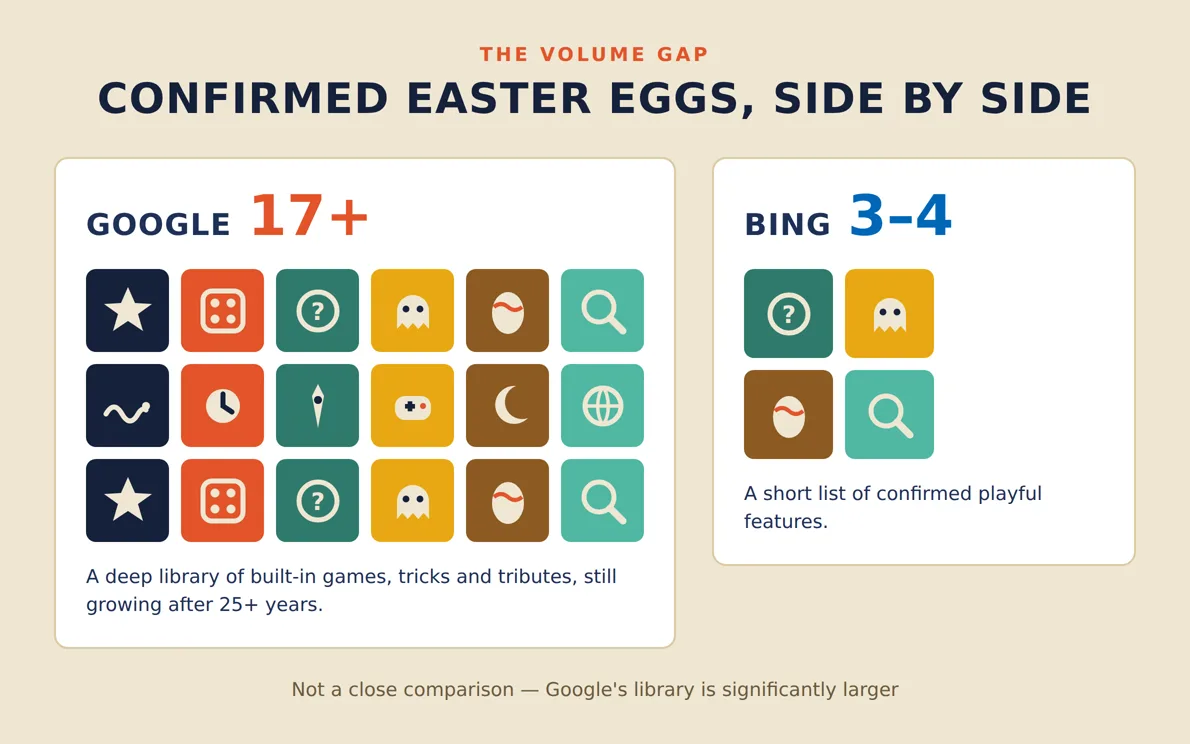
Google — 17+
Confirmed Easter eggs and interactive features
Bing — 3–4
Confirmed Easter eggs (several others claimed)
This is not a close contest in pure Easter egg volume. Google has invested more engineering time in playful search surprises than Bing has, and it is not meaningfully debatable.
The more interesting question is why. Google’s early identity was built on the premise that search could be magical — fast, surprising, and occasionally delightful. The Doodles, the Easter eggs, the “I’m Feeling Lucky” button: these are all expressions of the same belief that a search engine could have personality. Bing, arriving years later in a market Google had defined, had to make harder choices about engineering investment. Its answer to personality was the homepage photography — beautiful, human, and different from Google’s near-blank white interface.
Neither approach is wrong. They reflect different views about where delight belongs in a search product.
Timeline
A Brief Timeline of the Google–Bing Rivalry
2009
Microsoft replaces Live Search with Bing. The new brand emphasizes decision-making and homepage imagery. Google’s first Easter eggs are already several years old.
February 2011
Google reveals its “honeypot” experiment. The nonsense queries hiybbprqag and mbzrxpgjys appear in Bing’s results, triggering the Copygate controversy. Bing neither confirms nor denies the specific mechanism but defends its use of clickstream data.
2012
Google adds the “Zerg Rush” Easter egg — the same year the term peaks in mainstream search traffic. Bing has no equivalent pop-culture Easter egg response.
2013–2015
Voice search misrecognitions produce viral Bing moments. Google’s “OK Google” assistant launches. The voice search market develops as a new front in the rivalry.
2019
Google’s Wizard of Oz Easter egg marks the film’s 80th anniversary. Bing has no equivalent anniversary Easter egg tradition in search results.
2020
Google retires the Atari Breakout Easter egg on Google Images (it had run since approximately 2013). Microsoft adds OpenAI integration to Bing, pivoting toward AI-powered search.
2023
Microsoft relaunches Bing with GPT-4 integration as “the new Bing” / Copilot. AI Overviews and conversational search begin to reshape what “Easter egg” might even mean in a search engine.
January 2025
Bing briefly displays a Google-resembling interface during a testing experiment. Screenshots go viral. Microsoft rolls back.

2026
Google maintains 17+ Easter eggs across its search results. Bing’s Easter egg count remains small, with the homepage Spotlight and Snake being its most distinctive playful features.
Looking Ahead
What About AI Search Engines?
The search landscape in 2026 includes more than just Google and Bing. Perplexity, ChatGPT Search, and other AI-native search tools have entered the market. None of them have Easter egg traditions in the Google sense — though a few have playful behaviors built into their conversational interfaces (asking a GPT-based tool what 2 + 2 is in a silly way sometimes produces silly responses).
The Easter egg as a genre belongs to a specific era of software culture: one where engineers had enough creative latitude and job security to hide jokes in products that millions of people used daily. As search moves toward AI-generated answers and conversational interfaces, the traditional Easter egg — a visual effect triggered by a specific search query — may become a legacy form. Google’s 17+ Easter eggs already feel like a living museum of a certain kind of engineering culture from the 2000s and 2010s.
Try it yourself: The quickest way to understand the difference between Google and Bing’s Easter egg philosophy is to open both search engines and type “do a barrel roll.” Google spins. Bing returns standard results. That tells you everything about this comparison in about three seconds.

Go Deeper on Google Easter Eggs
FAQ
Frequently Asked Questions
Does Bing have Easter eggs like Google?
Bing has a small number of Easter eggs and fun features, but significantly fewer than Google. Confirmed Bing Easter eggs include a playable Snake game (search “snake game” on Bing) and a Solitaire game. Bing’s homepage also features daily photography with interactive hotspots, which is a different kind of delight. Google has 17+ confirmed Easter eggs across its search results, including fully playable games like Pac-Man, Minesweeper, and the Dinosaur Game, plus visual effects like Do a Barrel Roll and Askew.
Did Bing copy Google search results?
In 2011, Google engineers ran a “honeypot” experiment: they planted fake search results for nonsensical queries like hiybbprqag — terms that had no real meaning and no real results to index. Those same fake results subsequently appeared in Bing’s search index. Google concluded that Bing was using clickstream data collected through Internet Explorer and the Bing toolbar (observing what Google users searched for and clicked on) to inform Bing’s results. Microsoft did not deny using clickstream data as a ranking signal. The incident was widely called “Copygate” in technology media. Microsoft maintained that its use of behavioral signals was legal and did not constitute copying.
What games does Bing have built into search?
Bing has confirmed a Snake game (search “snake game” on Bing) and a Solitaire game. These are simpler implementations than Google’s versions. Google’s in-search games include Pac-Man, Snake, the Dinosaur Game, Solitaire, Minesweeper, and Tic-Tac-Toe — all with more features and polish than Bing’s counterparts.
Does Bing have an Atari Breakout Easter egg?
This is widely claimed online but difficult to verify as an active, confirmed feature. Google had an Atari Breakout Easter egg on Google Images (searching “Atari Breakout” turned the image results into a playable Breakout game) from approximately 2013 until it was retired in May 2020. Claims that Bing has a similar Easter egg may be confused with Google’s retired feature, may reflect a feature that worked in a specific region or time period, or may be inaccurate. We have not confirmed an active Bing Atari Breakout Easter egg as of 2026. If you try it and it works, Bing may have added it — or re-added it — after this article was written.
Why does Google have so many more Easter eggs than Bing?
Google’s engineering culture has historically given individual engineers significant creative latitude. The famous “20% time” policy (where engineers could spend a portion of their time on personal projects) produced not just Gmail and Google News but also many of the Easter eggs. Bing, which launched years after Google had defined the category, made different engineering investment decisions. Bing’s answer to the question “how do we make search enjoyable?” was primarily its homepage photography and Spotlight features rather than hidden search tricks. Neither answer is wrong — they reflect different philosophies about where delight belongs in a search product.
What happened when Bing looked like Google in January 2025?
In January 2025, multiple users reported that Bing’s search results page was temporarily displaying a visual design that closely resembled Google’s layout, including fonts, spacing, and color choices that echoed Google’s results interface. Screenshots spread across social media. Microsoft acknowledged the incident as a “testing experiment” that had been deployed more broadly than intended and rolled it back. The incident was notable primarily because it came fourteen years after the Copygate controversy and prompted considerable irony from technology observers. UI A/B testing is common in search engines, but the visual similarity to Google was unusual and created significant commentary.
Which search engine is more fun to use?
This depends on what “fun” means to you. Google has far more Easter eggs, interactive games, and hidden visual effects — if you enjoy discovering surprises in a search engine, Google wins decisively. Bing has a more visually beautiful homepage with daily photography and interactive trivia, which some users find more engaging than Google’s minimal white interface. For pure Easter egg quantity and quality, Google is the clear winner. For daily homepage aesthetic, Bing is the more intentional choice.
What is the “hiybbprqag” Google–Bing experiment?
Hiybbprqag was one of a set of nonsense queries that Google engineers planted into their search index with fake results as part of a “honeypot” experiment in 2010–2011. Because the query was meaningless, the only way Bing could have returned the same result was by observing that Google users had searched for it and clicked on Google’s result, then incorporating that behavioral signal into Bing’s ranking. When the same fake result appeared in Bing, Google used it as evidence that Bing was using IE and Bing toolbar clickstream data to harvest information from Google’s users. The story was first published by Search Engine Land’s Danny Sullivan and became one of the most discussed incidents in search engine history.
Can I find Google Easter eggs that work on both Google and Bing?
No. Google Easter eggs like “do a barrel roll,” “askew,” “zerg rush,” and “blink html” are built into Google’s own results page and do not trigger on Bing. Searching those same terms on Bing returns standard search results. Both search engines have their own implementations of Snake and Solitaire, but Google’s versions are more fully featured. The only Easter egg-like features that exist on both platforms are the built-in calculator and unit converter, which both search engines offer as standard utility features.
What is the most famous Google Easter egg that Bing has no equivalent of?
Do a Barrel Roll is arguably the most famous, as it is instant, dramatic, and memorable on first encounter. Searching “do a barrel roll” spins the entire Google results page 360° — a trick that has no Bing equivalent. Pac-Man is also a strong candidate: Google’s embedded Pac-Man is a complete, 255-level arcade game with the original sounds, accessible to anyone with a Google Search result, and Bing has nothing comparable. Both Easter eggs have been driving internet searches and social media shares for over a decade.
Try the Easter Eggs Google Has
We’ve documented all 17+ Google Easter eggs in detail — how to trigger them, their history, and what to do when they stop working.
Summary
Summary
Google has more Easter eggs than Bing. By a wide margin. This is not a controversial conclusion — it is simply a count. Google has 17+ confirmed hidden tricks, games, and visual effects embedded in its search results. Bing has a handful, with Snake being the most clearly documented.
The more interesting comparison is philosophical. Google’s Easter egg tradition reflects a particular moment in tech culture when an engineer with a good idea and enough goodwill could ship a 360-degree page spin as a product feature. Bing’s contribution to search delight has been the homepage — a different bet, on photography and curation rather than hidden tricks.
And then there is Copygate: the incident that defined the rivalry more than any feature comparison ever could. It is not an Easter egg. It is a story about two companies, a set of nonsense search queries, and what happens when one company decides to be clever about catching what it suspects its competitor is doing.
Google won that particular battle decisively. On Easter eggs, the story is the same.
Sourced Sources: Search Engine Land (Danny Sullivan, 2011 Copygate reporting), Ubergizmo (Bing Snake game documentation), Stefan Weitz statement (Microsoft VP, February 2011), Bing Newsroom, CNET, The Verge (January 2025 Bing-as-Google report), Nishan Lamin (Google vs Bing Easter egg comparison), Alphabet Q4 2022 earnings release (Google search market share figures).