Google in 1998: The Easter Egg That Shows What Google Used to Look Like
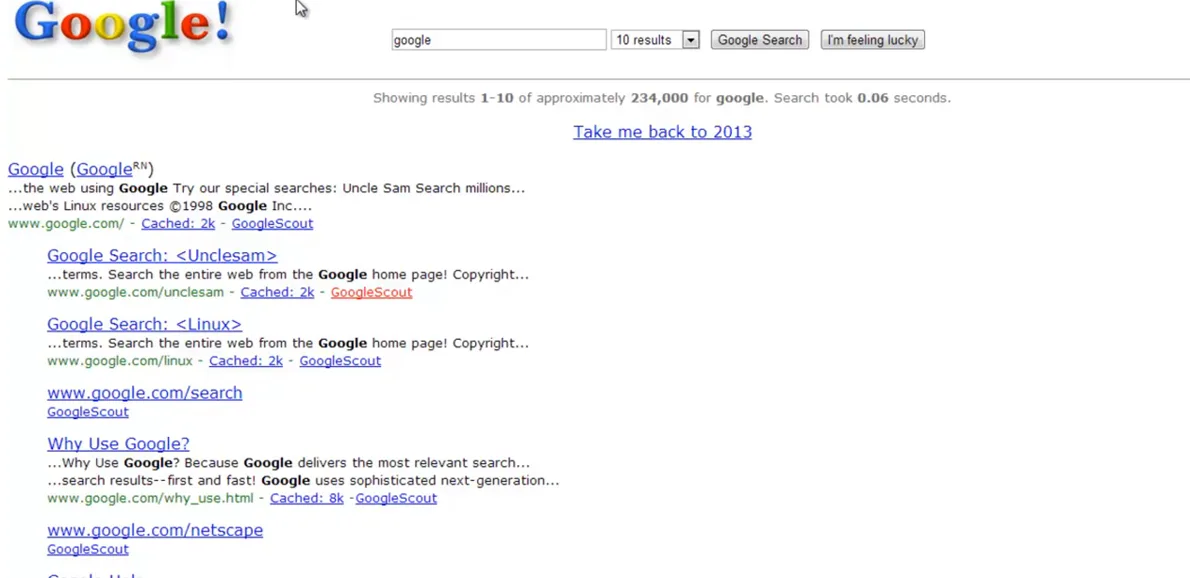
Search google in 1998 on Google.com and the search results page transforms into a recreation of Google’s original 1998 design — a retro, minimalist results layout styled to look like the web did nearly three decades ago. The results themselves are current (you’ll see real search results for your query), but the visual presentation mimics Google’s early interface: basic blue links, sparse styling, an older logo, and none of the modern cards, images, or Knowledge Panels that appear today.
Every major tech company has a moment when it was just two people in a garage with a server made from Lego bricks. For Google, that moment was 1998. Larry Page and Sergey Brin had just incorporated their company and were running the entire search engine from a 1.4TB storage system inside a borrowed Stanford dorm room. The homepage was a plain white page. The logo looked different. The results were text links. That was it.
The “Google in 1998” Easter egg takes today’s powerful search engine and skins it to look like that early version — a nostalgic, brief window into web history that takes about five seconds to trigger.
How to Trigger the “Google in 1998” Easter Egg
- Open your browser and go to google.com
- In the search bar, type google in 1998 (three words, exactly as written)
- Press Enter or click Search
- The results page will load and then apply a visual transformation — the layout shifts to mimic Google’s 1998 design style
- The results themselves are still current and accurate — only the visual presentation changes
- The retro design applies to the full results page, including the header, search bar styling, and result cards
You can still search from the 1998 view
The retro styling doesn’t lock you in. You can type a new search query in the search bar while the 1998 style is active, and the results page for that query will also appear in the retro style. It persists until you navigate away from the search results.
What Does the 1998 Google Design Look Like?
The Easter egg applies a visual skin that references Google’s early design language. Key visual changes include:
- An older Google logo style — simpler, with different typography and coloring than the current logo
- Plain blue hyperlinks — results appear as basic underlined blue text links, without the modern card-style formatting
- Minimal page chrome — fewer navigation elements, tabs, and interface controls
- No featured snippets, Knowledge Panels, or People Also Ask boxes — these features didn’t exist in 1998
- A simpler, text-heavier layout — more like a basic HTML page than a modern web application
- Retro font rendering — the typography references the style of late-1990s web design
What Was Google Actually Like in 1998?
Google was incorporated as a company on September 4, 1998. Prior to that, it operated as a research project called “BackRub” at Stanford University, where Page and Brin were PhD students studying under professor Terry Winograd. The name “Google” is a deliberate misspelling of “googol” — the mathematical term for 10 to the power of 100 — a reference to the project’s ambition to organize the vast amount of information on the web.
The 1998 Google hardware setup
In 1998, Google’s entire search index was stored on a custom-built computer server assembled using Lego bricks (for the case) at Stanford. The server had 1.4 terabytes of storage — a significant amount for 1998. Andy Bechtolsheim (a Sun Microsystems co-founder) wrote the first check to “Google Inc.” for $100,000 before the company was even officially incorporated, forcing Page and Brin to formally incorporate to cash it.
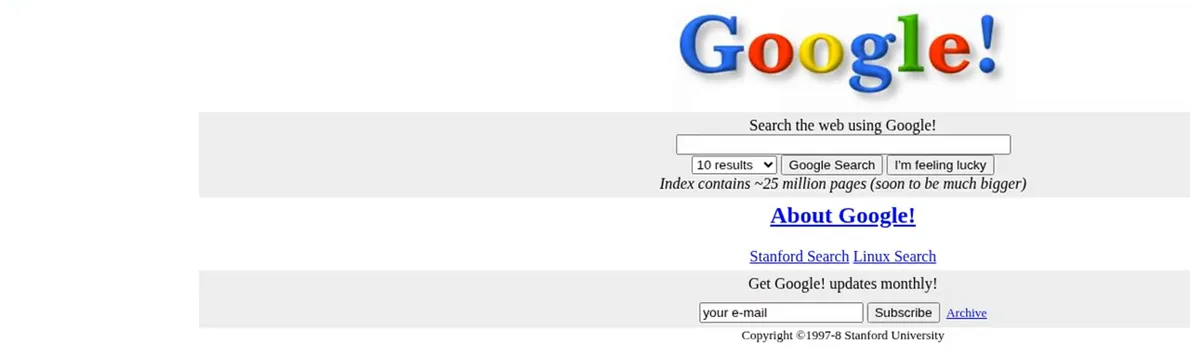
The original Google homepage was famous for its extreme simplicity — in an era when Yahoo, Excite, and AltaVista were loading their homepages with news tickers, horoscopes, stock quotes, shopping links, and email portals, Google’s homepage was almost completely empty. A logo, a search box, two buttons. That’s all.
This wasn’t an accident. Page and Brin wanted Google to be fast to load on the slow dial-up connections of the time — and they were the only ones who knew how to build the backend, not the frontend. The simplicity was partly ideology, partly necessity.
Google’s Index Size in 1998
When Google launched to the public in 1998, it indexed approximately 25 million web pages. For context:
- AltaVista (then considered the largest search engine) indexed roughly 150 million pages
- The entire World Wide Web was estimated to contain around 1–2 billion pages in 1998
- Google’s index was smaller than its competitors, but its PageRank algorithm produced significantly more relevant results
- By 2026, Google’s index covers hundreds of billions of web pages and continuously crawls trillions of URLs
Google’s Design Evolution: 1998 to 2026
| Feature | Google in 1998 | Google in 2026 |
|---|---|---|
| Homepage elements | Logo, search box, 2 buttons | Logo, search box, voice, camera, Apps, Sign in |
| Results format | Plain blue links with text snippets | Cards, featured snippets, Knowledge Panels, images, videos, AI Overviews |
| Search index size | ~25 million pages | Hundreds of billions of pages |
| Products | Web Search only | Search, Maps, Gmail, Drive, Photos, YouTube, Android, Chrome, Cloud, and more |
| Server infrastructure | 1.4TB on Lego-built server in a dorm room | Global network of hundreds of data centers |
| Search speed | Seconds (dial-up era) | Under 0.5 seconds average |
| Daily searches | ~10,000 perday (est.) | ~8.5 billion per day (est.) |
| Page loading style | Basic HTML, minimal CSS | Full JavaScript web app with real-time rendering |

Why Does This Easter Egg Exist?
The “Google in 1998” Easter egg is a piece of institutional memory — Google acknowledging its own history and inviting users to experience a bit of what came before. The company regularly celebrates milestones in its own history, and this Easter egg lets anyone visit a simplified recreation of the original interface at any time.
It also works as a demonstration of how far web design has advanced. The difference between 1998’s text links and 2026’s AI-powered search cards is visible in the ten seconds it takes to see the transformation. The Easter egg doesn’t just show nostalgia — it shows scale.
Google engineers who built this Easter egg understood that not every user is old enough to remember dial-up internet and the pre-Google search landscape. The Easter egg makes that history accessible to anyone who’s curious enough to search for it.
More Google Easter Eggs
- Do a Barrel Roll — search “do a barrel roll” to spin the page
- Google Askew — search “askew” to tilt the results page
- Google Gravity — the third-party simulation where Google’s homepage falls
- All Google Easter Eggs (2026 Master List)
Frequently Asked Questions
How do I see Google in 1998?
Go to google.com and search google in 1998. The search results page will transform into a recreation of Google’s original 1998 visual design — showing the retro layout, older logo style, and sparse text-link format that Google used when it first launched. The results themselves are current; only the visual design changes.
What did Google look like in 1998?
The real 1998 Google homepage was extremely simple — an almost entirely white page with a colorful Google logo, a search box, and two buttons (“Google Search” and “I’m Feeling Lucky”). There was no navigation menu, no images, no news feed, no advertising. The results page showed plain blue hyperlinks with text snippets. Archived screenshots are available at web.archive.org (the Wayback Machine).
When was Google founded?
Google was officially incorporated as a company on September 4, 1998. Larry Page and Sergey Brin, PhD students at Stanford University, had been developing the search technology since 1996 under the name “BackRub.” The name “Google” is a deliberate misspelling of “googol,” the mathematical term for 10 to the power of 100, reflecting the founders’ ambition to organize the web’s vast information.
Does the “Google in 1998” Easter egg show real 1998 search results?
No. The “Google in 1998” Easter egg applies a visual skin to current, real search results. You see today’s search results for the query “google in 1998” — but displayed in a visual style that mimics 1998 Google’s design. It’s a cosmetic change, not a time machine. To see actual archived web content from 1998, visit the Wayback Machine at web.archive.org.
How many pages did Google index in 1998?
When Google launched in 1998, it indexed approximately 25 million web pages. At the time, this was smaller than competitor search engines like AltaVista (about 150 million pages), but Google’s PageRank algorithm produced more relevant results. By 2026, Google’s index covers hundreds of billions of pages and processes approximately 8.5 billion searches per day.
Does “Google in 1998” work on mobile?
Yes, the “Google in 1998” Easter egg can trigger on mobile browsers (Chrome for Android, Safari for iOS). The retro visual design is applied to the mobile search results layout. The effect may be less dramatic on a small screen than on a desktop browser, since the 1998 design was originally built for desktop monitors.
Can I use the 1998 Google style for multiple searches?
Yes. While the 1998 visual style is active, you can type new queries in the search bar and the results for those queries will also appear in the retro 1998 layout. The style persists as long as you stay within the search results page. Navigating away (clicking a result link, going to a different page) will end the retro display.
Where did Google’s founders work in 1998?
In 1998, Larry Page and Sergey Brin worked out of a rented garage in Menlo Park, California — owned by Susan Wojcicki, who would later become CEO of YouTube. Before the garage, they ran the project from Stanford dorm rooms while completing their PhD research. The garage served as Google’s first official office after the company was incorporated in September 1998.
What search engines existed before Google in 1998?
In 1998, several search engines preceded or competed with Google: AltaVista (launched 1995, known for large index), Yahoo (launched 1995, originally a directory), Excite (1993), Lycos (1994), Infoseek (1994), and Ask Jeeves (1997). Most of these were either directories (human-curated links) or keyword-matching search engines. Google’s PageRank algorithm, which ranked pages by the quality and quantity of links pointing to them, produced significantly more relevant results and quickly won users over.
Is the “Google in 1998” Easter egg available in 2026?
Yes, the “Google in 1998” Easter egg is available in 2026. Like all Google Search Easter eggs, its availability can vary — some users may see standard results rather than the retro design due to A/B testing or regional differences. If it doesn’t trigger for you, try in an incognito browser window or a different browser.
Explore Google’s Full Easter Egg Collection
“Google in 1998” is one of dozens of hidden tricks, games, and surprises hidden in Google Search. See the complete 2026 list of everything that still works.
Summary
The “Google in 1998” Easter egg is triggered by searching google in 1998 on Google.com. The results page transforms into a visual recreation of Google’s original 1998 design — sparse, text-heavy, with an older logo, plain blue hyperlinks, and none of the modern features (Knowledge Panels, featured snippets, AI Overviews) that define Google Search today. The results themselves remain current and accurate; only the visual presentation changes. Google was founded September 4, 1998 by Larry Page and Sergey Brin, operating initially from a Stanford dorm room and later a rented garage in Menlo Park. Their PageRank algorithm and extreme interface simplicity distinguished them from every competitor. The Easter egg is a piece of institutional nostalgia that remains available in 2026.
Sources: Google Search (tested October 2026); Google corporate history; Wayback Machine archived pages of google.com (1998); Stanford Digital Library project documentation; Steven Levy, In The Plex: How Google Thinks, Works, and Shapes Our Lives (2011). Sourced